
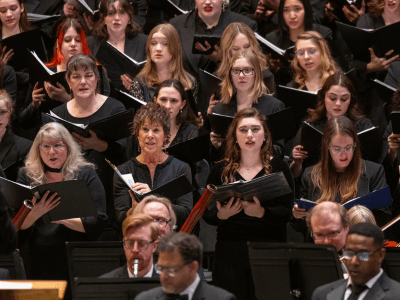
Symphony No. 3 in D minor
Gustav Mahler (GOO-stahf MAH-ler)
Born July 7, 1860 | Kalischt, Bohemia
Died May 18, 1911 | Vienna, Austria
Orchestration: 4 flutes (2 doubling piccolo); 4 oboes, (4th doubling English horn), 3 B-flat clarinets (3rd doubling bass clarinet), 2 E-flat clarinets; 4 bassoons (4th doubling contrabassoon); 8 horns, 4 trumpets (one an offstage posthorn, an ancestor of the valved cornet), 4 trombones, tuba; timpani, glockenspiel, tambourine, cymbals, side drum, triangle, bass drum, chimes, tam tam, rute [a birch or wire brush]; 2 harps; women’s chorus, boys’ chorus, alto solo and strings
Gustav Mahler loved the outdoors. Nature’s beauty delighted him. He treasured long walks in the countryside where he could observe nature’s power and magic. Between 1891 and 1897, Mahler conducted both opera and symphony in Hamburg, Northern Germany’s largest city. Between seasons, in the breathtaking valleys of the Salzkammergau in the Austrian Alps, he immersed himself in composing, for which there was little time during the performance season. Summer brought him peace and seclusion. Inevitably, the sounds of nature found their way into his music. The large orchestras of Mahler’s symphonies stem, in part, from his desire to approximate the sounds that so enthralled him: bird songs, wind rustling in leaves, sheep bleating, church bells pealing, and the popular music of rural Austria.
From its inception, the Third Symphony was Mahler’s expression of his love for nature; more than one critic has called it his “Pastoral” Symphony. Yet it is not entirely bucolic. Mahler focuses on nature’s power and occasional harshness as well as its beauty. Writing to his mistress Anna von Mildenburg in August 1896, Mahler reported:
My symphony is going to be something the likes of which the world has not yet heard. All nature is voiced therein, and it tells of deeply mysterious matters. . . . I tell you, at certain passages I myself sometimes am overcome with an uncanny feeling, and can hardly believe that I could have written them.
His original titles for the Symphony’s movements were:
1. Summer marches in
2. What the flowers of the meadow tell me
3. What the animals of the forest tell me
4. What night tells me
5. What the morning bells tell me
6. What love tells me.
Mahler’s eventual German and Italian movement titles are conventional musical directives, rather than those initial romantic imaginings. They provide interpretive and tempo guidance, not programmatic inspiration. Biographer Deryck Cooke describes the first movement of the Third Symphony as “the most original and flabbergasting thing Mahler ever conceived.” It is undeniably arresting. A commanding horn melody opens the symphony eight horns strong, leaving us little doubt about Mahler’s perception of the sweep and power of nature.
The formidable strength of the brasses at the front end may be construed as the cruelty of winter. Summer’s gentle minions find their stride in subtler ways, and the dark forces of winter do not yield their seasonal hold easily. Therein lies the struggle in Mahler’s musical evocation of nature’s greatest miracle, the annual cycle of rebirth. Describing the first movement to his friend Natalie Bauer-Lechner, wrote:
Summer marches in” will be the Prologue. Right away I need a regimental band. . . . Naturally, they don’t get by without a battle with the opposing force, winter, but he is soon thrown out of the ring, and summer, in his full strength and superiority, soon seizes undisputed leadership.
Before he abandoned the programmatic references altogether, Mahler arrived at the right description for the “introduction”: “Pan’s Awakening” followed by “Summer Marches In.” Because it is so long (more than half an hour), the opening movement provides a natural divider for the Third Symphony into two parts, with the other five movements comprising the second part.
Mahler recognized the need for some relief after the dramatic tension of his opening. That is one reason that all the middle movements are relatively short. The second movement, a minuet, is markedly delicate in comparison to the first, with lighter scoring that emphasizes woodwinds more than brass.
We hear Mahler at his most lighthearted in the third movement, Comodo; Scherzando; Ohne Hast. He based this movement on an early song, “Ablösung im Sommer,” one of the earliest (1887-1890) of his songs based on Achim von Arnim and Clemens Brentano’s early 19th-century folk collection, Des Knaben Wunderhorn [The Youth’s Magic Horn]. Folk dances and country melodies dominate, while Mahler’s effective orchestration draws a mocking aural picture of the crises, joys, and practical jokes at a rustic village celebration. His music bears a firm Austrian imprint here. Mahler celebrated the commonplace, rather than apologizing for it. One section toward the end is marked grob [coarse, rude], almost emphasizing the humble inspiration of the music. “It is as if Nature herself were pulling faces and putting out her tongue,” he told Natalie Bauer-Lechner.
The final three movements of the Third Symphony are played without pause, which reinforces their thematic and spiritual relationship to one another. In the fourth movement, the first slow segment in the symphony, Mahler introduces the contralto soloist. Her text, by Friedrich Nietzsche, raises questions about destiny, existence, and the relationship between joy and pain, day and night: heady material, from which Mahler does not shy.
After the profound questions raised by the first alto solo, the boys’ choir sings the delightful “Bimm-bamm” chorus. They sound like a positive reaffirmation of life, youth, and life after death. With the women’s chorus, the angels join the churchbells.
For Mahler, an Adagio was not a psychological point of repose or regeneration. It was a climax, the vehicle for the most profound expression of reverence and spiritual devotion. In short, it was the highest form of art. Ultimately, he was an instrumental composer, and for a conclusion to this monumental symphony, the eloquence of the orchestra was the only appropriate forum for his finale. Both choruses and the alto soloist are silent for the heartfelt last movement. Mahler’s orchestral sound shimmers, growing in a power that first matches and eventually surpasses that of the opening movement. For Mahler, love was a more powerful force even than nature; spiritual love was the mightiest of all.
This information is protected by copyright and is provided solely as a benefit to Kalamazoo Symphony patrons.
Reproduction in any form without written permission from the Program Annotator is strictly prohibited.
Become a Season Subscriber
A season ticket subscription to the Kalamazoo Symphony gives you the best seats at the best prices and access to unforgettable memories and music all season long!