Beethoven’s Violin Concerto
Laurie Shulman, Program Notes Annotator
Lucas Richman | Concerto No. 2 for Violin: Legacy (World Premiere) with Lauren Yoon
Alexander Glazunov | Violin Concerto in A minor with Jinan Laurentia Woo
Ludwig van Beethoven |Violin Concerto in D Major with Benjamin Beilman

Concerto No. 2: Legacy for Violin & Orchestra
Lucas Richman
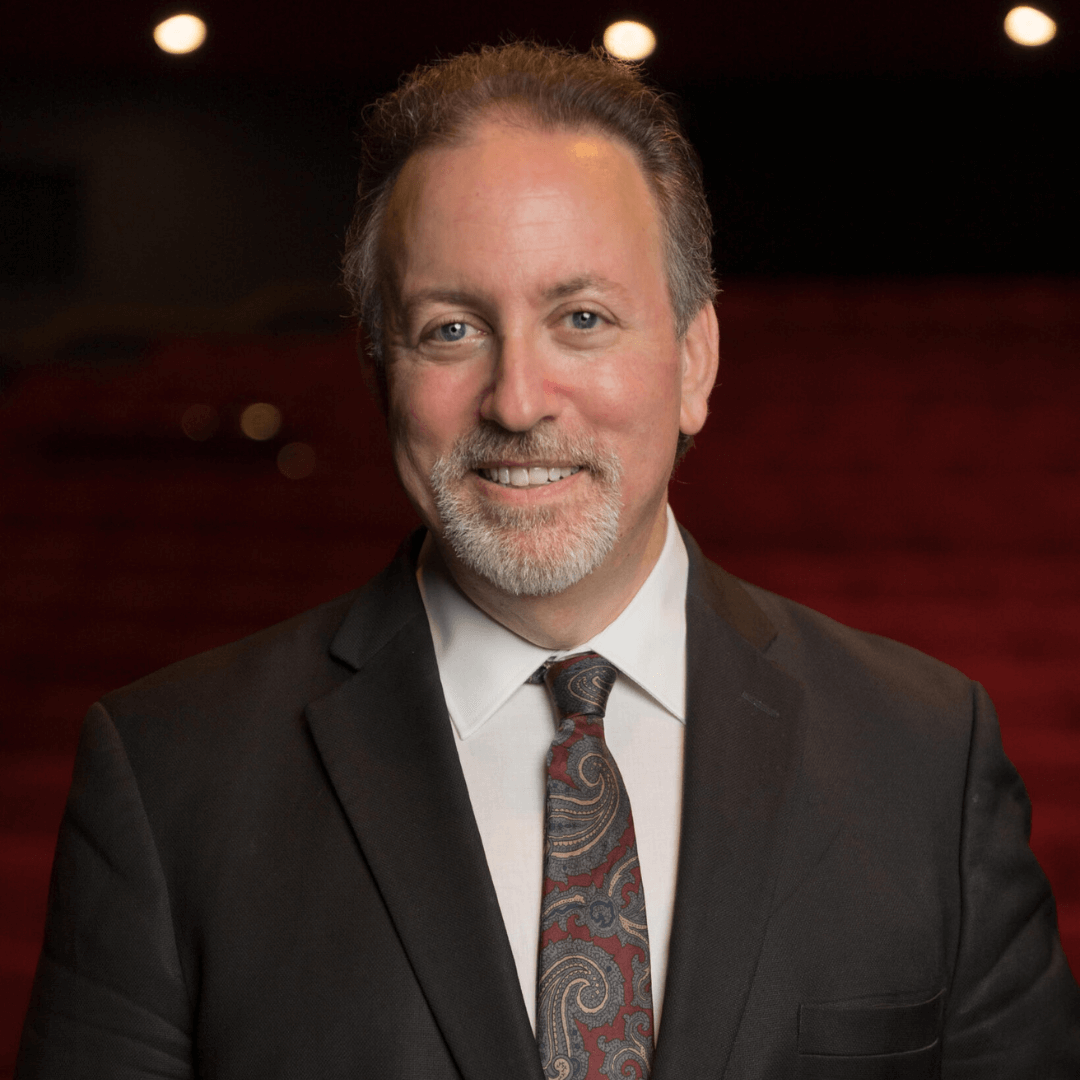
We are thrilled to have Lucas Richman with us for the World Premiere of his Concerto No. 2
Orchestration: 2 flutes, 2 oboes, 2 clarinets, 2 bassoons, 2 horns, 2 trumpets, 1 trombone, timpani, harp, solo violin and strings
Lucas Richman has long been established as a composer, having had his works performed by more than 200 orchestras throughout the United States. He has fulfilled commissions for numerous organizations, including the Pittsburgh Symphony, San Diego Symphony, the Debussy Trio, and Frequency Opera, the latter of which led to the 2024 Vatican premiere of his chamber opera, Blood & Breath. Richman is also a distinguished conductor; he has led the Bangor [ME] Symphony Orchestra since 2010, and served as music director of the Knoxville Symphony from 2003 to 2015. He holds a degree in violin performance from UCLA and a master’s in conducting from USC. For this evening’s world premiere, the Stulberg International String Competition commissioned Richman to write a violin concerto in honor of conductor and educator Julius Stulberg. Richman says that Legacy is about the impact teachers and mentors can have on future generations. His composer’s note explains.
The concerto’s three movements share three distinct musical motives, including the common thread of a six-note motive, D-E-G-A-C-D (LEGACY), woven throughout the piece in various forms. The second prominent motive used in each movement originates in the second movement’s opening aria, a musical declamation of a quote from the Greek philosopher Pericles, “What you leave behind is not what is engraved in stone monuments, but what is woven into the lives of others.” Additionally, the name, “Stulberg,” is featured prominently throughout in the form of 8 pitches (E-F-G-D-B-E-D-G), which have been assigned to the 8 letters in the family name.
The titles of the work’s three movements come from the long list of quotable phrases (“Stulbergisms”) issued by Maestro Stulberg to his young musicians in the Kalamazoo Junior Symphony Orchestra over the course of his 31 years as the organization’s leader. The first movement, “My Dear Children,” is youthful in its energy, with a second theme (derived from the initials of the four Stulberg children, David, Joshua, Bernard, and Mira with their parents, Esther and Julius: D-C-B-F-E-C) providing a lyric and soulful contrast.
The second movement, “A Teachable Moment,” is a fantasia ruminating on mentors and their influence throughout history. The Legacy motive provides an underpinning for the Pericles quote. articulated by the soloist in a rhythmic declamation of the original Greek text. The solo violin version of “A Teachable Moment” was adapted for solo viola and solo cello, as well as solo bass, for use in the 2025 Stulberg International String Competition. Consequently, violinist Lauren Yoon was chosen from a field of twelve semi-finalists to be the soloist for the world premiere of the work with the Kalamazoo Symphony.
After the cadenza, the third and final movement, “Meet You at the End,” begins with a solo string quartet representing the four Stulberg children playing a melody derived from alternating letters of the names of their parents. This quickly gives way to a joyful, scampering display of buoyant virtuosity, all of which leads to a celebratory coda and a rousing finish.
With respect to the Greek quotation from Pericles, Richman explains that he likes to set the text as if it were to be sung, then remove the words so that an instrumental aria remains. He often generates musical material by assigning pitches based on a grid:
A B C D E F G
H I J K L M N
O P Q R S T U
V W X Y Z
“I then adjust accidentals [sharps and flats] as I see fit,” he explains. This type of musical spelling has frequently been adopted by earlier composers, most notably Bach, Schumann, and Shostakovich. In German, for example the letter B stands for B-flat, and the pitch “B” designates B-natural; similarly, ‘As’ stands for A-flat and ‘Es’ stands for E-flat. This alternative orthography expands the pitch material available to a composer, and many composers take liberties with musical spelling, as Richman has done. While the audience is unlikely to perceive these motivic building blocks – especially on a first hearing – their use can be a useful tool to a composer. Richman offers, “Starting with a blank page can be daunting. With this motivic generator, I feel as if I’m starting with material that is somehow already tied to the ideas I would like to express. For Legacy, I have not used any pre-existing melodies; everything is original.”
His concerto adheres to the traditional format of three movements arranged fast-slow-fast. Richman writes in a tonal, melodious idiom with ready conversation between the violin soloist and the orchestra. The soloist sometimes embroiders the melodic line with triplets or scalar figuration. The first movement migrates through several key centers, but opens and closes in E-flat major.
A string chorale opens the slow movement, presently joined by a soulful solo violin line that is distinctly operatic and sometimes recitative-like. Richman introduces the teaching moment, which evolves to a more unsettled middle section. When he returns to the chorale, it is with extensive variation in the soloist’s line. The movement concludes with an unaccompanied cadenza that alludes to the concerto’s themes, intertwined with neo-Baroque arpeggiation and other virtuoso techniques. Richman proceeds without pause to the finale, which begins with another slow introduction but soon propels itself into a dance-like celebration in perpetual motion. Syncopations and jazzy rhythms add to its appeal, as the concerto hurtles forward to a thrilling conclusion.
Violin Concerto in A minor, Op. 82
Alexander Glazunov
Born August 10, 1865 in St. Petersburg, Russia
Died March 21, 1936 in Paris, France
Orchestration: 3 flutes, piccolo, 2 oboes, 2 clarinets, 2 bassoons, 4 horns, 2 trumpets, 3 trombones, harp, timpani, percussion, solo violin, and strings
An overview of Alexander Glazunov’s life reads like a “who’s who” of Russian 19th-century music, and his students anchor the legacy of Russian music in our century. As such, he is a pivotal figure. Glazunov was part of the generation of Russian composers born in the 1850s and ’60s who were the immediate heirs to the groundbreaking “Mighty Five”: Borodin, Balakirev, Cui, Musorgsky, and Rimsky-Korsakov. His contemporaries were Ippolitov-Ivanov, Liadov, Arensky, and Gretchaninov; against their music his stands up quite creditably. Possessed of a big talent that was recognized early, Glazunov benefited from two years of theory lessons with Rimsky-Korsakov during his youth. Balakirev also took an interest in him, dubbing him “the little Glinka” when he was still a teenager. Indeed, when Glazunov’s first symphony was successfully performed in 1882 — he was only sixteen — he seemed destined for a brilliant career.
One of Russian music’s mysteries is the lack of fulfillment of that early promise. To be sure, Glazunov found considerable success as a composer and was a major figure in Russian music by the turn of the century. In 1906, he became director of the St. Petersburg Conservatory, from which position he wielded great power up until the Russian Revolution. But his largely instrumental compositions did not find a unique personal expression; his music reflects a strong Wagnerian bent, and also the influence of Tchaikovsky, who was extremely popular during the 1880s. The waves of change sweeping over Russia in the 1860s had largely subsided by the 1880s, when Glazunov was coming of age. As his biographer Gerald Abraham has observed, “Glazunov learned to speak music with a Russian accent, but not to think musically in Russian.”
Although he lived well into the 20th century, Glazunov’s musical ethos was firmly anchored in the 19th century. His works tend to be traditional in approach, reflecting a gift for orchestration and a penchant for rich harmonies. He was most at home with instrumental music, producing 8 symphonies, 2 piano concerti, and several significant ballets. His important works are for the most part youthful compositions. The Violin Concerto, which dates from 1904, is the outstanding example, and remains Glazunov’s most frequently performed and best known composition.
Cast in one large movement, a form Glazunov favored, the Violin Concerto consists of three distinct segments that approximate traditional concerto form; however, one structural experiment distinguishes it. The slow movement, an Andante in D-flat major, is a lengthy episode inserted where we expect the development section of the opening Moderato. At its conclusion, the Moderato resumes as if the slow movement were a normal development. Glazunov makes it work by relating both the melodic shape and the rhythm of the Andante theme to the main theme of the first movement, yet he provides musical variety by the switch in tonality (from A minor to D-flat major) and a metric switch from 4/4 to 3/4.
At the conclusion of the recapitulated Moderato, a brilliant solo cadenza provides the transition to the finale, whose bright and assertive main theme is a veritable fanfare. With strong martial overtones, it eradicates any thoughts of sentimentality that might have lingered from the tender, slow movement. The Violin Concerto is dedicated to Leopold Auer (1845-1930), dean of the Russian violin school, who played the premiere. The abundance of rich melodic material and technical fireworks for the soloist suggests that Auer may have had more than a passing role in its evolution.
Concerto in D major for Violin and Orchestra, Op. 61
Ludwig van Beethoven
Born December 16, 1770 in Bonn, Germany
Died March 26, 1827 in Vienna, Austria
Orchestration: flute, pairs of oboes, clarinets, bassoons, horns and trumpets, timpani, solo violin, and strings
Five gentle taps on the timpani open Beethoven’s sublime Violin Concerto. From that gesture springs the entire first movement: its leisurely, unhurried pace, its emphasis on internal examination rather than external show, and of course the motivic substance from which the music is constructed, in Beethoven’s incomparable fashion. These five beats are a stable foil to the woodwind theme, marked dolce [sweetly], that answers them and eventually emerges as the principal melody of the movement.
The same five strokes, understated yet inexorable, firmly anchor the Allegro, ma non troppo in the tonic key of D major. They are a welcome homing point in light of the disorienting and unexpected D-sharps (significantly, repeating the same rhythm of the opening timpani strokes) that the first violins interject as early as the tenth measure.
A cornerstone of the solo violin literature, Beethoven’s Violin Concerto is so familiar that listening to it becomes a special experience. Our ears are finely tuned for detail, because we recognize, or think we recognize, everything we hear. We are at once greeting an old friend, and learning something remarkable and new about that friend, something that never surfaced in an earlier conversation. Part of Beethoven’s genius lies in the fact that his music continues to speak to us even after repeated hearings. If anything, our perception and appreciation of its message and communicative power increase with greater acquaintance.
Thus, it is doubly astonishing to think that, after the Violin Concerto’s premiere in 1806, it only received one additional documented performance in Beethoven’s lifetime, and that was in Berlin rather than Beethoven’s adopted city of Vienna. According to Beethoven’s biographer Boris Schwarz:
As late as 1855, the eminent Louis Spohr – who rejected the late works of Beethoven while enthusiastically approving Richard Wagner, said to [Joseph] Joachim after a performance of the Beethoven Concerto, “This is all very nice, but now I’d like to hear you play a real violin piece.
Why did this concerto take so long to win friends?
For one thing, it is not a flashy vehicle that focuses on the soloist’s brilliant technique. A pianist who played some violin, Beethoven studied the repertoire of prominent contemporary violinist-composers such as Viotti, Kreutzer, and Rode, in order to become more conversant with the technical possibilities of the violin. Display for its own sake never eclipses the broader musical architecture of this mighty work. In this realm, Brahms was Beethoven’s most distinguished emulator. Among Beethoven’s own compositions, the Violin Concerto’s closest spiritual sibling is the Piano Concerto No. 4 in G major, Op.58. The two works share serenity, absolute conviction in an inherent balance, and a lack of need for overt display. It is surely no accident that these two works are contemporary.
About the music
Several factors contribute to the length of the Violin Concerto’s opening Allegro ma non troppo: a full double exposition, the addition of an extra episode during the development section, a full recapitulation without truncation, plus a solo cadenza and coda. (One of the concerto’s surprising features is that Beethoven never awards the cantabile second theme to his soloist until the coda.)
Beethoven’s Larghetto, built on variation principles, is sheer embroidery. Only muted strings and pairs of clarinets, bassoons, and horns accompany the soloist. The eminent British writer Donald Francis Tovey observed:
Beethoven uses variation form in order to express a sublime inaction in his slow movements. In the Violin Concerto, the theme is a single strain with an echo, and the inaction is the more impressive by reason of two episodic themes which intervene between the later variations, and which are even more confined to the home tonic than the theme itself.
The recurrent, descending bass line relates the movement to the Baroque chaconne. Beethoven’s quasi-archaic orchestral approach allows the soloist an extravagance of embellishments. Whereas the Fourth Piano Concerto’s slow movement dialogue is rhetorical, dramatic, even combative, in the Violin Concerto the mood is comfortable, even friendly. Beethoven’s geniality carries through to the Rondo finale, whose double-stopped episodes are the only such instances in the concerto. Taking unusual and beguiling advantage of the violin’s high register, the finale provides wonderful opportunities for the soloist to display discerning taste and polished execution.
This information is protected by copyright and is provided solely as a benefit to Kalamazoo Symphony patrons.
Reproduction in any form without written permission from the Program Annotator is strictly prohibited.
Become a Season Subscriber
A season ticket subscription to the Kalamazoo Symphony gives you the best seats at the best prices and access to unforgettable memories and music all season long!