Beethoven’s Fourth Symphony
Laurie Shulman, Program Notes Annotator
Fanny Mendelssohn Hensel | Overture in C major
Antonín Dvořák | Violin Concerto in A minor with Mio Imai
Ludwig van Beethoven | Symphony No. 4 in B-flat major

Overture in C major, H265
Fanny Mendelssohn Hensel (FAN-ee MEN-dəl-zohn HEN-səl)
Born 14 November 1805 in Hamburg, Germany
Died 14 May 1847 in Berlin, Germany
Orchestration: woodwinds in pairs, four horns, two trumpets, timpani, and strings
The eldest of Abraham and Leah Mendelssohn’s four children, Fanny Mendelssohn was three and a half years older than her brother Felix. She was equally gifted as a pianist and composer, but was discouraged by her father from pursuing a professional career in music. Felix supported her composition efforts, but disapproved of her publishing any of her pieces. (Ironically, several of her songs were published under Felix’s name in the 1820s.)
Fanny married the artist Wilhelm Hensel in 1829. Hensel was court painter to the Prussian king. He had a more progressive view with respect to his wife’s talents, and encouraged her to continue composing. Under Fanny’s stewardship, their Berlin home became a favored spot for house concerts; she was the salon hostess par excellence. The majority of Fanny’s more than 300 compositions were songs and piano miniatures, but she did produce some larger dramatic pieces in the 1830s. In the 1840s, contravening her father’s and brother’s wishes, she began to publish her music. Her works were starting to garner critical acclaim when she died of a massive stroke in May 1847. She was 41.
Sonata Form
a type of composition in three sections
The Overture in C major is Hensel’s only surviving piece for orchestra alone. It comprises a slow introduction and a sonata-form allegro, conforming with common symphonic practice of the day. It dates from 1832, when she was 26, and is contemporary with two cantatas, an oratorio, and a dramatic scene for soprano and orchestra. She conducted the premiere in her Berlin residence at a Sunday concert in 1834.
Allegro di molto
movement performed very fast or lively
Hensel opens with a slow introduction in triple meter that is reminiscent of Beethoven in its dialogue between strings and woodwinds. A dramatic violin run heralds an Allegro di molto, with the meter changing to a military march, punctuated by timpani rolls and brass fanfares. First and second themes are clearly delineated. Hensel moves directly to her development section, navigating through several key centers before returning to the home tonality of C major. Her final section, marked Più presto e sempre accelerando, brings the overture to an exciting and decisive close.
Più presto e sempre accelerando
faster and always accelerating
Violin Concerto in A minor, Op. 53
Antonín Dvořák (AHN-toh-neen DVOH-zhak)
Born 8 September, 1841 in Mühlhausen, Bohemia
Died 1 May, 1904 in Prague, Czechoslovakia
Orchestration: woodwinds and trumpets and pairs, four horns (two in F, two in D), timpani, violin solo, and strings.
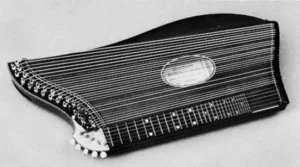
Zither
a stringed instrument with 30 to 40 strings over a shallow, horizontal soundboard
Zither
a stringed instrument with 30 to 40 strings over a shallow, horizontal soundboard
The Austro-Hungarian violinist Joseph Joachim (1831-1907) is closely linked with Johannes Brahms. From their meeting in 1853, the two men were lifelong friends, surviving some serious personal quarrels because of mutual admiration for each other’s composing and performing prowess. The most obvious legacy of this remarkable friendship is the music for violin that Brahms composed, particularly the Violin Concerto in D, Op. 77 (1878) and the violin/piano sonata in G, Op. 78 (1870).
The magnificence of those two works and the powerful relationship between the two men has overshadowed somewhat Joachim’s far-reaching influence on his other contemporaries. Most significant are his collaborations with Max Bruch and Antonín Dvořák on their respective violin concerti. The case of the Dvořák Concerto is particularly intriguing because Brahms was Dvořák’s principal mentor in the Viennese musical establishment, and in fact placed his younger Bohemian colleague in touch with Joachim expressly for the purpose of obtaining advice regarding the new concerto.
A violinist himself, Dvořák was more comfortable with string instruments than with the keyboard, and his concerto, Op. 53 shows far more assurance than the earlier Piano Concerto in G minor, Op. 33. Dvořák benefited from the appearance of Brahms’ Violin Concerto in 1879, drafting his own in a matter of months. Curiously, though Joachim was quite fond of Dvořák’s chamber music, particularly the Sextet, Op. 48, and the E-flat string quartet, Op. 51, he never warmed up to the new concerto. Dvořák undertook extensive revisions after his first meeting with the famous violinist to discuss the new work. The original version has not survived, but by Dvořák’s own acknowledgment, the entire concerto was altered.
Joachim sat on the second version for more than two years. Even then, he called for further revisions and substantial cuts in the finale. Ironically, after this lengthy gestation period, Joachim did not introduce Dvořák’s concerto. Nor did he ever play the work in public. The premiere took place in Prague in October 1883 with a Czech violinist, Frantisek Ondříček, as soloist. He was quite famous in his day and an enthusiastic fan of Dvořák’s music.
Despite this turgid birthing process, the concerto has found many friends, and is well-liked by violinists and audiences. Symphonic in concept, it overflows with the profusion of melodies that Brahms so envied in Dvořák. Joachim’s imprint is perhaps best discerned in the first movement’s virtuosic figuration and the elaborate melodic intricacies of the lovely slow movement. The finale is clearly modeled on the finale of the Beethoven concerto, but not at the expense of individuality: Dvořák cast it as a furiant. Midway through, he interjects a dumka. The finale’s similarity in character to the Slavonic Dances surely accounts for its considerable popularity.
Furiant
a Czech dance with shifting meters
Dumka
a ballad, often with a quality of lamentation
Symphony No. 4 in B-flat major, Op. 60
Ludwig van Beethoven (LOOD-vig van BAY-toh-ven)
Born 16 December, 1770 in Bonn, Germany
Died 26 March, 1827 in Vienna, Austria
Orchestration: woodwinds, horns, and trumpets in pairs; timpani and strings.
Among Beethoven’s nine symphonies, the odd-numbered ones are the “biggies” that almost everybody knows by reputation, if not well enough to identify immediately. His Ninth, the “Choral” Symphony, concludes with the famous “Ode to Joy,” which schoolchildren can hum. Though the Seventh bears no nickname, it is a major work on a large scale, and a favorite of many Beethoven lovers. Everyone acknowledges the universal appeal of “fate knocking on the door” in Beethoven’s Fifth. The “Eroica” changed the scope of the symphonic genre, and is forever associated with Napoleon’s 1803 invasion of Vienna. And the First is, well, Beethoven’s first symphony, and a farewell to the eighteenth century.
Of the even-numbered symphonies, only the Sixth, the “Pastoral,” can reckon with the colossuses mentioned above. For many years, Symphonies Nos. 2, 4, and 8 took a back seat to the others. Then, in the 1970s, something of a backlash took place. For a while, the Fourth was the most frequently performed Beethoven symphony in the United States! It has been alternately overlooked and overplayed.
Composer Robert Schumann referred to the B-flat symphony as “a slender Greek maiden between two Norse giants.” His assessment makes sense in the context of the “Eroica” and the Fifth Symphonies, but should not persuade the listener that this work is lacking in fire or passion. The Fourth Symphony is relatively free of the conflict and tortured purpose that dominate the symphonies that preceded and followed it. Composed in 1806, it shares an overall aura of serenity with other major compositions Beethoven completed that year: the Fourth Piano Concerto, Op. 58 and the Violin Concerto, Op. 61. Those two masterworks are a better framework in which to consider the Fourth Symphony.
Allegro
movement performed at a brisk tempo
Beethoven prepares us for a serious, weighty experience with his slow introduction to the first movement. Winds and strings open pianissimo, tiptoeing about in ominous B-flat minor, destination uncertain. We anticipate a movement in minor mode, but he fools us, launching into a lighthearted Allegro in B-flat major, full of delicacy and verve. Syncopation and canon play a major role in this exuberant opener. In the slow movement, an Adagio in E-flat major, Beethoven spins a gloriously long theme out of primarily stepwise motion, adding rhythmic and textural interest through the underlying accompaniment and in the bridge passages. He adds drama with unexpected use of the timpani, so often silent in slow movements.
Canon
the repetition of a melody, played at different times, like the song “Frère Jacques”
Cat-and-mouse chases between woodwinds and strings characterize the scherzo, in which a mischievous, unlikely melodic figure derives from an arpeggiated diminished seventh chord. The intervening trio provides some delightful solo woodwind opportunities. Flute, oboe, clarinet, and bassoon each have additional occasions to shine in the finale. Here, Beethoven celebrates his classical heritage with Haydnesque humor, plus a dash of Beethovenian practical joking thrown in for spice.
Scherzo
movement that is typically playful, light-hearted, and often lively
Beethoven worked on the Fourth Symphony during the summer of 1806, completing it in the autumn. In early February 1807, he sold it to Count Franz von Oppersdorf for six months’ private use. Beethoven gave two concerts in the home of either Prince Lichnowsky or Prince Lobkowitz in March, and scholars believe that the symphony received its first performance at one of those concerts.
This information is protected by copyright and is provided solely as a benefit to Kalamazoo Symphony patrons.
Reproduction in any form without written permission from the Program Annotator is strictly prohibited.
Become a Season Subscriber
A season ticket subscription to the Kalamazoo Symphony gives you the best seats at the best prices and access to unforgettable memories and music all season long!